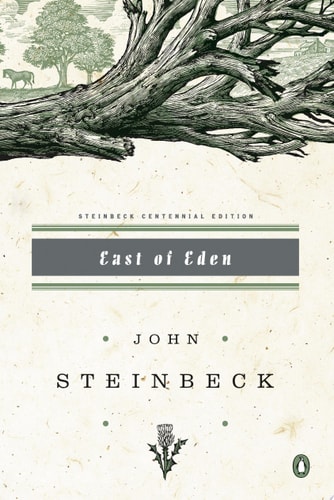
East of Eden
John Steinbeck
Gripping multi-generational saga. Couldn't put it down.
Date Read: 2026-04-17
Recommendation: 5/5
Notes:
You can boast about anything if it’s all you have. Maybe the less you have, the more you are required to boast.
And it never failed that during the dry years the people forgot about the rich years, and during the wet years they lost all memory of the dry years. It was always that way.
When a child first catches adults out—when it first walks into his grave little head that adults do not have divine intelligence, that their judgments are not always wise, their thinking true, their sentences just—his world falls into panic desolation. The gods are fallen and all safety gone. And there is one sure thing about the fall of gods: they do not fall a little; they crash and shatter or sink deeply into green muck. It is a tedious job to build them up again; they never quite shine. And the child’s world is never quite whole again. It is an aching kind of growing.
A thing so triumphantly illogical, so beautifully senseless as an army can’t allow a question to weaken it. Within itself, if you do not hold it up to other things for comparison and derision, you’ll find slowly, surely, a reason and a logic and a kind of dreadful beauty. A man who can accept it is not a worse man always, and sometimes is a much better man. Pay good heed to me for I have thought long about it. Some men there are who go down the dismal wrack of soldiering, surrender themselves, and become faceless. But these had not much face to start with. And maybe you’re like that. But there are others who go down, submerge in the common slough, and then rise more themselves than they were, because—because they have lost a littleness of vanity and have gained all the gold of the company and the regiment. If you can go down so low, you will be able to rise higher than you can conceive, and you will know a holy joy, a companionship almost like that of a heavenly company of angels. Then you will know the quality of men even if they are inarticulate. But until you have gone way down you can never know this.
nearly all men are afraid, and they don’t even know what causes their fear—shadows, perplexities, dangers without names or numbers, fear of a faceless death. But if you can bring yourself to face not shadows but real death, described and recognizable, by bullet or saber, arrow or lance, then you need never be afraid again, at least not in the same way you were before. Then you will be a man set apart from other men, safe where other men may cry in terror. This is the great reward. Maybe this is the only reward
The direction of a big act will warp history, but probably all acts do the same in their degree, down to a stone stepped over in the path or a breath caught at sight of a pretty girl or a fingernail nicked in the garden soil
It was his first sharp experience with the rule that without money you cannot fight money.
Time interval is a strange and contradictory matter in the mind. It would be reasonable to suppose that a routine time or an eventless time would seem interminable. It should be so, but it is not. It is the dull eventless times that have no duration whatever. A time splashed with interest, wounded with tragedy, crevassed with joy—that’s the time that seems long in the memory. And this is right when you think about it. Eventlessness has no posts to drape duration on. From nothing to nothing is no time at all.
In all such local tragedies time works like a damp brush on water color. The sharp edges blur, the ache goes out of it, the colors melt together, and from the many separated lines a solid gray emerges.