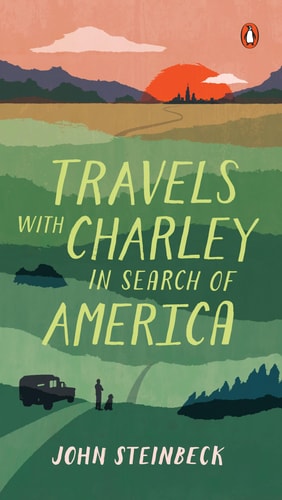
Travels with Charley in Search of America
John Steinbeck
Steinbeck sets off on a road trip across America with his pet poodle, Charley. Part meditation on travel, part exploration of America in the '60s. Reading it today, Steinbeck's disillusionment with consumerism, urbanization, loss of regional identity, and segregation seems prophetic.
Date Read: 2026-05-03
Recommendation: 5/5
Notes:
A journey is a person in itself; no two are alike.
It has personality, temperament, individuality, uniqueness.
We find after years of struggle that we do not take a trip; a trip takes us.
The techniques of opening conversation are universal.
The best way to attract attention, help, and conversation is to be lost.
I cannot write hot on an event. It has to ferment.
A kind of second childhood falls on so many men. they trade their violence for the promise of a small increase of life span.
I’ve lifted, pulled, chopped, climbed, made love with joy and taken my hangovers as consequence not as punishment. I did not want to surrender fierceness for a small fain in yardage.
In my own life I am not willing to trade quality for quantity. If this projected journey should prove too much then it was my time to go anyway. I see too many men delay their exists with a sickly, slow reluctance to leave the stage. It’s bad theater as well as bad living.
Humans had perhaps a million years to get used to fire as a things and as an idea … and now a force was in hand how much more strong, and we hadn’t had time to develop the means to think, for man has to have feelings and then words before he can come close to thought and, in the past at least, that has taken a long time.
I’ve lived in good climate and it bores the hell out of me.
For how can one know color in perpetual green, and what good is warmth without cold to give it sweetness?
A sad should can kill you quicker, far quicker than a germ.
We know so little of our own geography.
We have inherited many attitudes from our recent ancestors who wrestled with this continent as Jacob wrestled with the angel, and the pioneers won. From them we take a belief that every American is a natural born hunter.
The sun was up when I awakened and the world was remade and shining. There are as many worlds as there are kinds of days and as an opal changes its colors and its fire to match the nature of a day, so do I.
In Spanish, there is a word for which I can’t find a counter word in English. It is the verb vacilar, present participle varcilando. It does not mean vacillating at all. If one is vacilando, he is going somewhere but doesn’t greatly care whether or not he gets there, although he has direction.
Everything in the world must have design or the human mind rejects it. But in addition it must have purpose or the human confidence shies away from it.
Just as the Carthaginians hired mercenaries to do their fighting, we Americans bring in mercenaries to do our hard and humble work. I hope we may not be overwhelmed one day by peoples not too proud or too lazy or too soft too bend to the earth and pick up the things we eat.
The new American finds his challenge and his love in traffic chocked streets, skies nested with smog, checking with the acids of industry, the scratch of rubber and houses lashed in against one another while the town lets wither a time and die… This is not offered in criticism but only as an observation. And I am sure that, as all pendulums reverse their swing, so eventually will the swollen cities rupture like dehiscent wombs and disperse their children to the countryside. This is the prophecy underwritten by the tendency of the rich to do this already. Where the rich lead, the poor will follow, or try to.
In literary criticism, the critic has no choice but to make over the victim of his attention into something the size and shape of himself.
One of my main purposes was to listen, to hear speech, accent speech rhythms, overtones and emphasis. For speech is so much more than words and sentences. I did listen everywhere. It seemed to me that regional speech is in the process of disappearing, not gone but going. Forty years of radio and twenty years of television must have this impact. Communications must destroy localness, by a slow, inevitable process.
Just as our bread, mixed and baked, packaged and old without benefit of accident or human frailty, is uniformly good and tasteless, so will our speech become one speech.
The idioms, the figures of speech that make language rich and full of poetry of place and time must go. And in their place will be a national speech, wrapped and packaged, standard and tasteless. Localness is not gone but is going.
What I am mourning is perhaps not worth saving, but I regret its loss nonetheless.
Even while I protest the assembly-line production of our food, out songs, our language, and eventually our sounds, I know that it was a rare home that baked good bread in the good old days.
It is the nature of a man as he grows older, a small bridge at a time to protest against change, particularly change for the better. But it is true that we have exchanged corpulence for starvation, and either one will kill us.
The lines of change are down. We, or at least I, can have no conception of human life and human thought in a hundred years of fifty years. Perhaps my greatest wisdom is the knowledge that I do not know. The sad ones are those who waste their energy trying to hold it back, for they can only feel bitterness in loss and no joy in gain.
For three or four minutes I had a name, and the duties and joys and frustrations a man carries with him like a comet’s tail. It was like dodging back and forth from one dimension to another, a silent explosion of breaking through a sound barrier, a curious experience, like a quick dip into a known but alien water.
The delicate shades of feeling, of reaction, are the result of communication, and without such communication they tend to disappear. A man with nothing to say has no words. Can its reverse be true - a man who has no one to say anything to has no words as he has no need for words?
Only though imitation do we develop towards originality.
Can we then say that the America I saw has put cleanliness first, at the expense of taste? … If this people has so atrophies its taste buds as to find tasteless good not only acceptable but desirable, what of the emotional life of a nation? Do they find their emotional fare so bland that it must be spiced with sex and sadism through the medium of the paperback?
I learned long ago that the most important and valuable of acting techniques is the exit.
The American tendency in travel: one goes, not so much to see but to tell afterward.
I wonder why we think the thoughts and emotions of animals are simple.
People rarely take action on advice of others unless they were going to do it anyway.
It takes the time-stone of event to give a memory past dimensions. Eventlessness collapses time.
This sounds as though I bemoan an older time, which is the preoccupation of the old, or cultivate an opposition to changes, which is the currency of the rich and stupid.
I wonder why progress looks so much like destruction.
We value virtue but do not discuss it.
Could that be why the sequoias make folks nervous? Those natives were grown trees when a political execution took place on Golgotha. They were well towards middle age when Caesar destroyed the Roman republic in the process of saving it. To the sequoias everyone is a stranger and a barbarian.
We have in the past been forced into reluctant change by weather, calamity, and plague. Now the pressure comes from our biological success as a species. we have overcome all enemies but ourselves.
When I went away I had died, and so became fixed and unchangeable. My return caused only confusion and uneasiness. Although they could not say it, my old friends wanted me gone so that I could take my proper place in the pattern of remembrance - and I wanted to go for the same reason. Tom Wolfe was tight. You can’t go home again because home ceased to exist except in the mothballs of memory.
What I found was closely intermeshed with how I felt at the moment.
Charley doesn’t have our problems. He doesn’t belong to a species clever enough to split the atomic bomb but not clever enough to live in peace with itself.
Many a trip continues after movement in time and space have ceased.